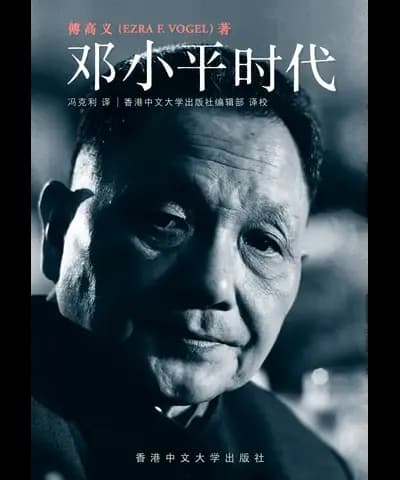
[书] 邓小平时代[Book] Deng Xiao ping and the Transformation of China
邓小平时代
这本书我用了大半个月读完,一直迟迟没动笔,不知道说什么,不知道能说什么
接下来我打算用 我的读法,我的心态,我的一点己见的结构完成这份非同一般的阅读体验的总结
我的读法
书的重量与历史的沉重感相当,可想而知这本大部头既需要沉下心集中读,更需动笔圈画和整理思绪。
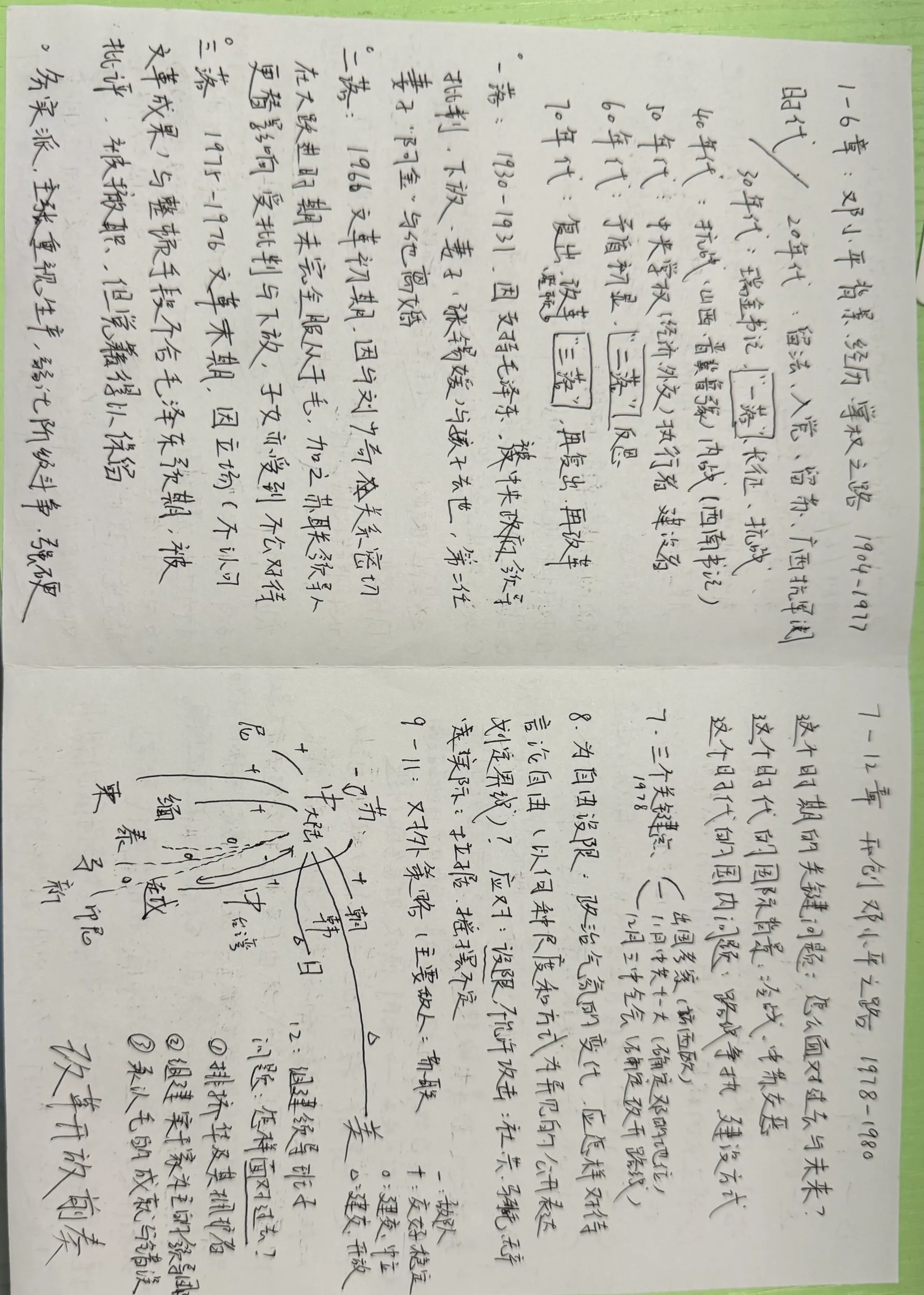
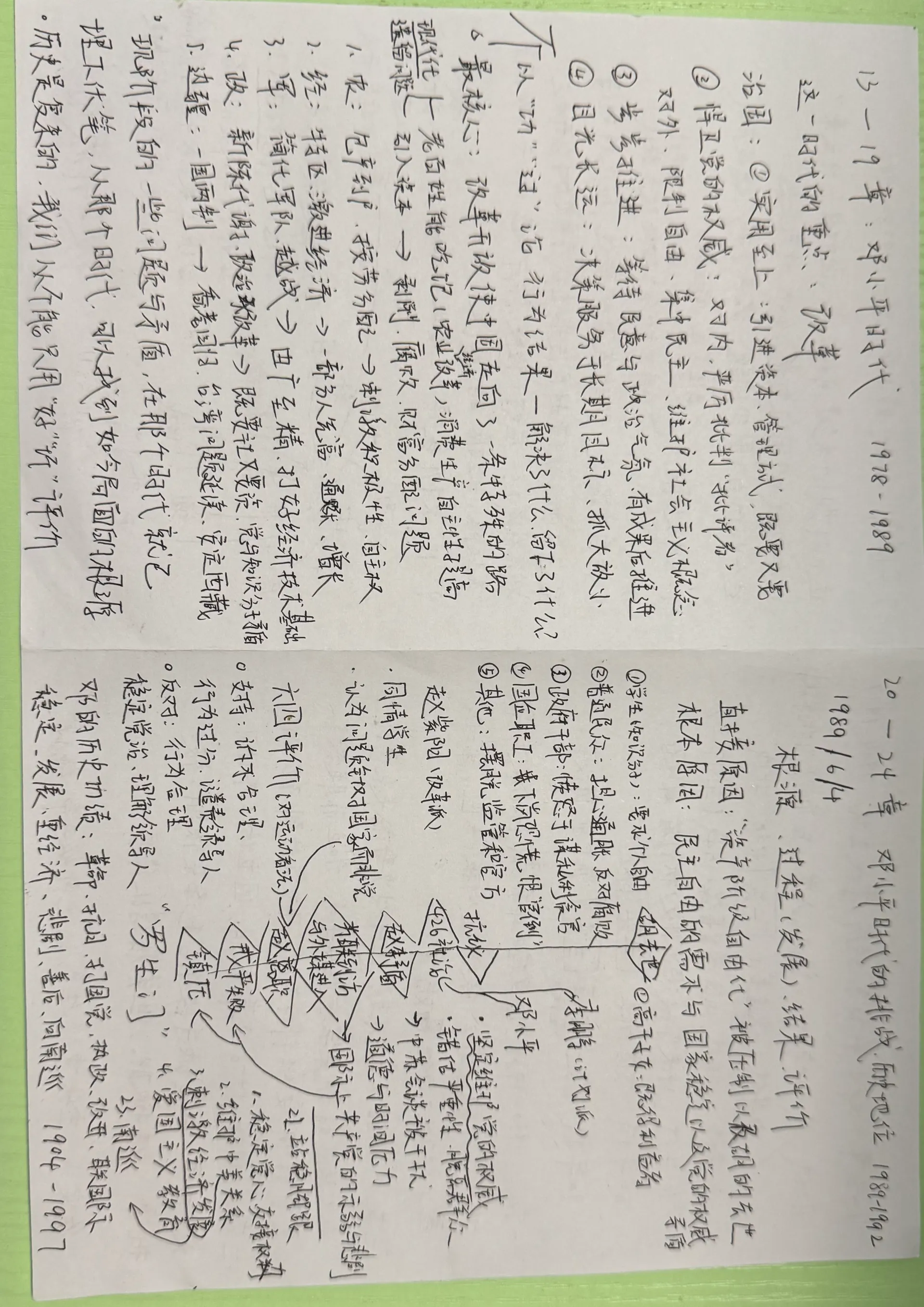
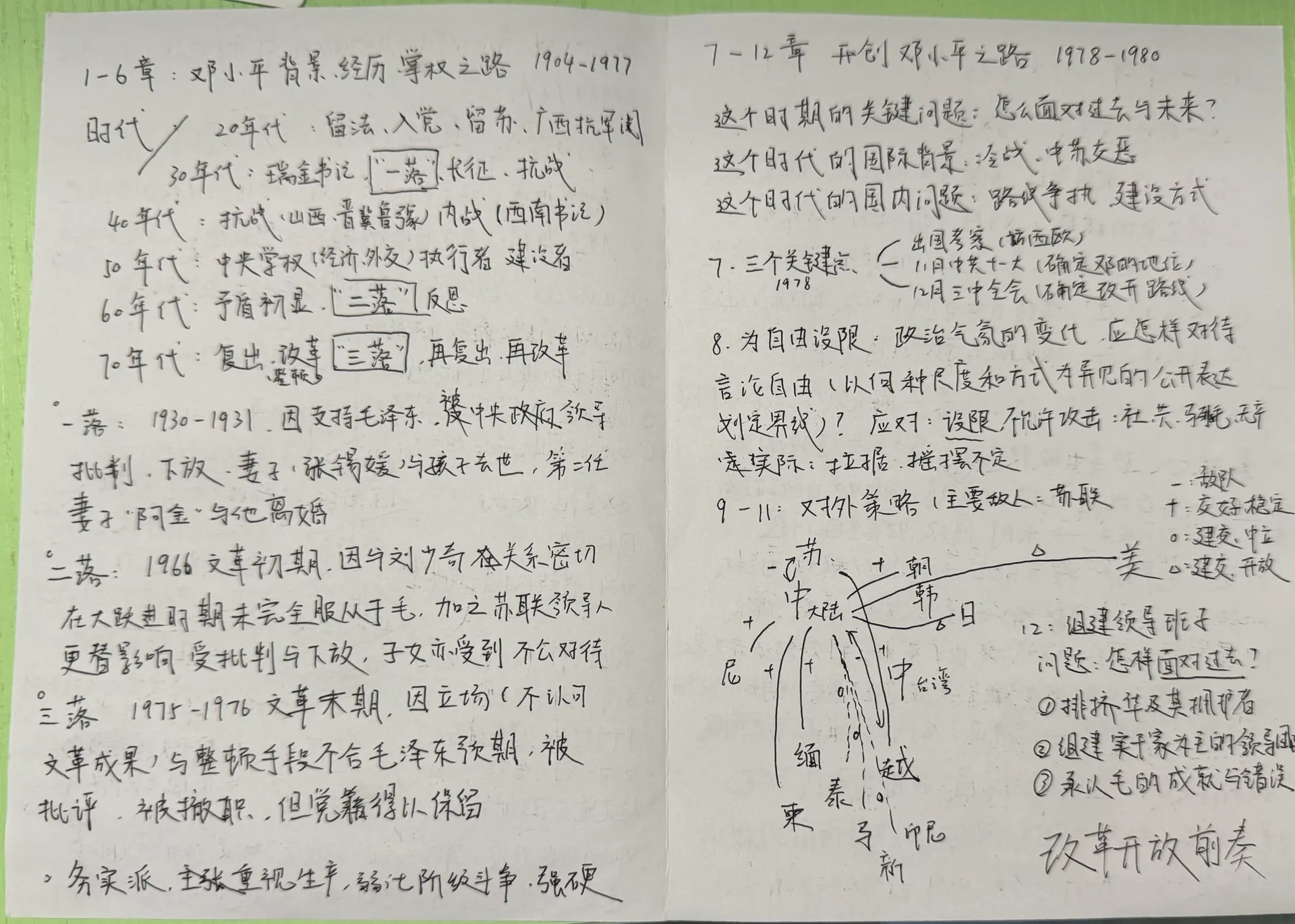
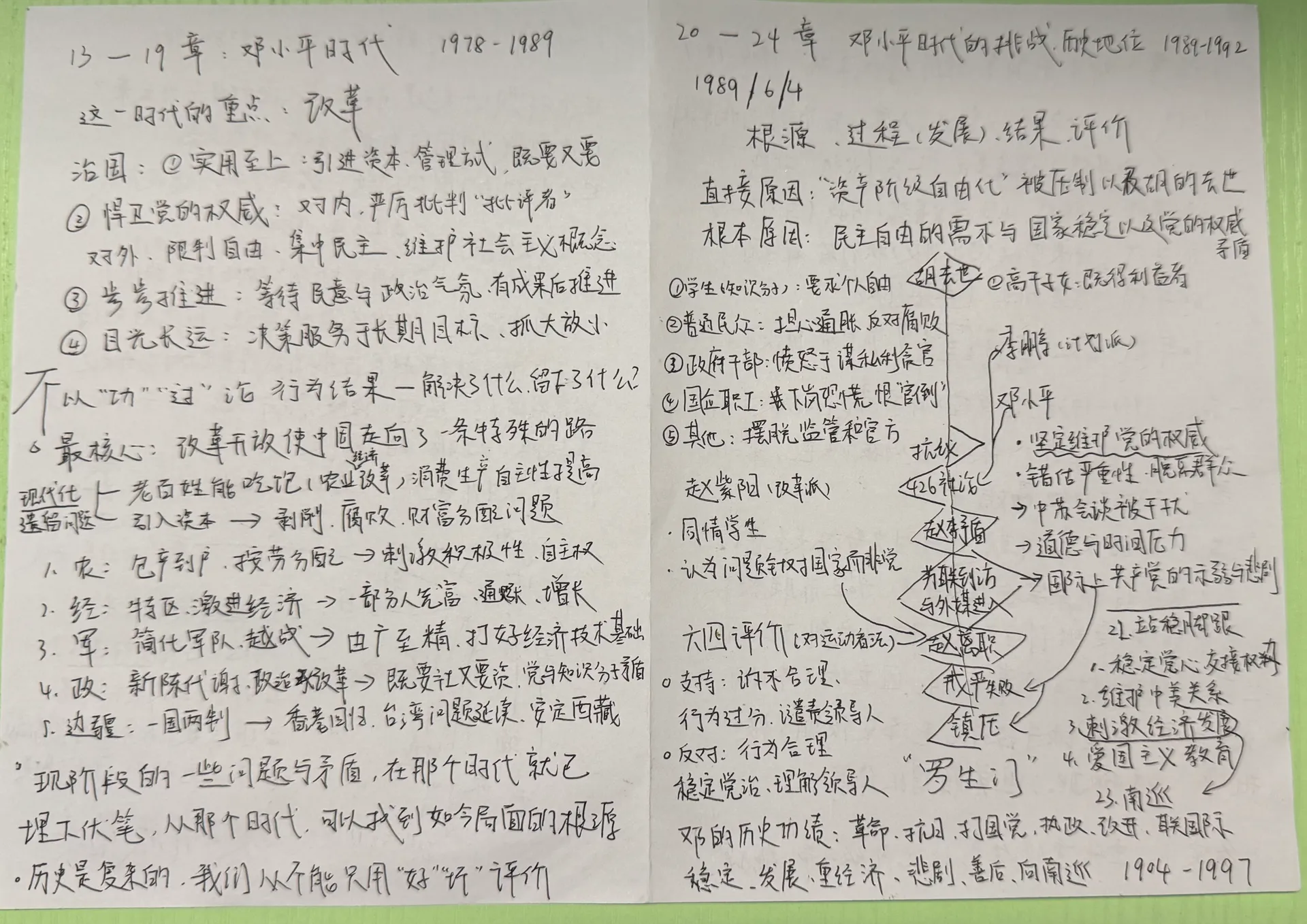
我先大致看了标题,了解了大概的时间脉络,既然如此,我也用时间段的方式记录下每章的内容,写在一A4纸上。
此书的后半部分(13章),建议从“邓小平时代的关键人物”来看,很多人物的动机与立场就放在这部分
于此,准备好一支笔和咖啡之类,就开始读
划线的用处
读书方法里我收益良多的就是这个,划线
引用b站up主(城主的地界)的看法,划线是用来强调与重读的,有些句子,划一遍就相当于再看一遍
同时,与我来说,划线是让我集中注意力到本书的方法,其也有记录阅读进度的作用
建立符号系统
符号系统,简单来说是用你的符号来”丝滑“标注出来文章各个部分的系统
比如,我用波浪线强调文章高光句子,或者重点见解
用圆圈标注第一次出场或陌生的人物
用多条线标注极为重要的句子
符号系统的好处我认为有两点,一个是检索,一个是交互:
检索不必说,当某个内容与前文有关联是,用划线和符号就很容易找出想找的句子,这个方法在百年孤独 的阅读中特别好用
重点是"交互"
我的理念是,知识是需要交互的,不管是哪方面的知识,知识不是单方面进入你的脑子,而是你与其产生链接与互动,然后吸收其中有用的部分
以及在交互的过程里能体会到读书的乐趣所在,就像打游戏一样,书也会给你反馈,只不过需要你耐心寻找
我的所谓心态
其实就是指: 未知全貌,不予断评
真正的历史存在,但了解真实全面的历史不可能,我们能做的就是综合不同的观点,在这个盲人摸象的过程中建立起对某个时代片段的理解
换句话说,我既然知道我认识的历史不够全面,那我更要以全面客观的角度观察哪些历史
这一心态尤其是当我读到书中"邓小平时代的挑战"一章时极为深刻
在此之前,我只对80年代末的历史有极为片面的见解,这些内容绝大部分的立场都鲜明地不得了,他们只需将每个主要角色置于对错的位置上,那么局势就立马清楚,不再有其他质疑
我无意批判这是否合理,但我并不希望只从结果论功过,因为一件事的动机,矛盾,背景,影响以及后人的解释角度都是这段历史不可摆脱的重要组成
只有从不同的视角看问题,才能得以理解不同视角的所思所想
若我们用一件事表面呈现的结果来判是非,一切复杂的历史就降维成了判断题,我们只需要根据现在的需要对哪些事件做判断即可
因而我重申,或者对可能不存在的读者你呼吁,一定要有自己的看法,就算没有,也不要盲套用别人的观点
一些己见
阅读过程中产生的一些想法
-
历史复杂,从没有对错
-
现阶段的一些问题与矛盾,在那个时代就已经买下伏笔
在这里我不会谈论争议话题,前人的功过只能任由时代评价,或许真有一天一切都会不一样,我们才认识到哪些所谓伤痛的意义
我们还有很长的路要走
Deng Xiao ping and the Transformation of China
It took me over half a month to finish this book, and I kept putting off writing about it, not knowing what to say, not knowing what I could say.
Next, I plan to structure this summary of an extraordinary reading experience around my reading approach, my mindset, and a few of my own views.
My Reading Approach
The weight of the book is comparable to the weight of history. One can imagine that this hefty tome requires not only calm, focused reading, but also pen-in-hand annotation and organizing of thoughts.
I first skimmed the chapter titles to get a general sense of the timeline. That being so, I also recorded each chapter's content by time period, writing it all on a sheet of A4 paper.
For the latter half of the book (Chapter 13), I suggest reading it through the lens of "key figures of the Deng Xiaoping Era"—the motivations and positions of many figures are placed in this section.
With that, I prepared a pen and some coffee, and began reading.
The Use of Underlining
Among reading methods, the one that has benefited me most is underlining.
Citing the view of a Bilibili creator (城主的地界), underlining is for emphasis and re-reading—some sentences, once underlined, are equivalent to reading them again.
At the same time, for me, underlining is a way to keep my attention focused on the book, and it also serves to record reading progress.
Building a Symbol System
A symbol system, simply put, is a system that uses your own symbols to "smoothly" annotate the various parts of a text.
For example, I use wavy lines to emphasize highlight sentences or key insights in the text.
I use circles to mark characters appearing for the first time or unfamiliar figures.
I use multiple lines to mark extremely important sentences.
I believe the benefits of a symbol system are twofold: retrieval and interaction.
Retrieval goes without saying—when something is related to earlier content, underlines and symbols make it easy to find the sentences you're looking for. This method was especially useful when reading One Hundred Years of Solitude.
The key point is "interaction."
My philosophy is that knowledge requires interaction. Regardless of what kind of knowledge it is, knowledge doesn't just enter your brain unilaterally—rather, you create links and interactions with it, and then absorb the useful parts.
And in the process of interaction, you can experience the joy of reading. Just like playing a game, the book will give you feedback—it just requires you to patiently seek it out.
My So-Called Mindset
It simply means: do not judge without knowing the full picture.
True history exists, but understanding the real and complete history is impossible. What we can do is synthesize different perspectives and, in this process of blind men touching an elephant, build an understanding of a fragment of an era.
In other words, since I know that the history I understand is not comprehensive enough, I must observe that history from a comprehensive and objective angle all the more.
This mindset was especially profound when I read the chapter "Challenges of the Deng Xiaoping Era."
Before that, I only had extremely one-sided views on the history of the late 1980s. The vast majority of these accounts had incredibly clear-cut positions—they only needed to place each major figure in a position of right or wrong, and the situation immediately became clear, with no further doubts.
I have no intention of criticizing whether this is reasonable, but I don't wish to judge merits and faults solely by outcomes, because the motives, contradictions, background, impact, and later interpretations of an event are all indispensable components of that history.
Only by looking at problems from different perspectives can one understand what different perspectives think and feel.
If we judge right and wrong by the surface-level results of an event, all complex history is reduced to true-or-false questions—we only need to judge which events based on current needs.
Therefore I reiterate, or appeal to you, the reader who may not exist: you must have your own views. Even if you don't, don't blindly apply others' opinions.
A Few Personal Views
Some thoughts that arose during the reading process:
-
History is complex; there has never been right or wrong.
-
Some of the problems and contradictions at the current stage were already foreshadowed in that era.
I will not discuss controversial topics here. The merits and faults of predecessors can only be left for the times to evaluate. Perhaps one day everything will be different, and only then will we recognize the meaning of so-called wounds.
We still have a long way to go.