[Agent]OpenAI构造智能体概览[Agent] OpenAI Building Agents Overview
需要复杂判断、规则难维护或大量处理非结构化信息用agent
Agent实际是一个自动化工作流
agent组成:LLM,tools,instructions
决定LLM
LLM选择:先用最有能力的模型进行任务,然后再通过用更小的模型替代它,找到平衡点
-
设置评估建立模型表现baseline
-
看准确率
-
优化成本和延迟
决定tools
LLM使用API调用模型
对于没有API的app,agent操作其UI来实现操作
tools的分类:
-
Data:允许LLM检索需要的信息
-
Action:与系统进行交互
-
Orchestration(编排):agent本身可以作为tool供其他agent使用
SDK:封装的代码库,是大模型调用工具,记忆和写作的基础设施
instruction的最好实践:
复用现有的文档,清晰语言,拆解任务,边缘情况处理
编排
编排有两种模式:单模型,多模型
while loop
所有编排都有一个“run”(开始),然后开始循环直到
达到退出条件(tool calls, a certain structured output, errors, or reaching a maximum number of turns.)
循环结束的情况只有:1.调用了final-output call 2。没调用任何tool并返回了结果
输入->LLM ->调用/不调用tools ->回到第二步/输出
用于复杂多agent任务的提示词工程:用一套具有延伸性的提示词可以简化维护以及增添case的成本
用多模型前: maximize a single agent’s capabilities first.
用多模型的原因:
-
逻辑过于复杂,单一提示词无法再扩展
-
工具重合度过高(overlaping)
两种多agent模式:
-
中心化:由一个central agent管理多个tools agent (类似调用函数)
-
去中心化:多个agent彼此协作(类似交接任务)
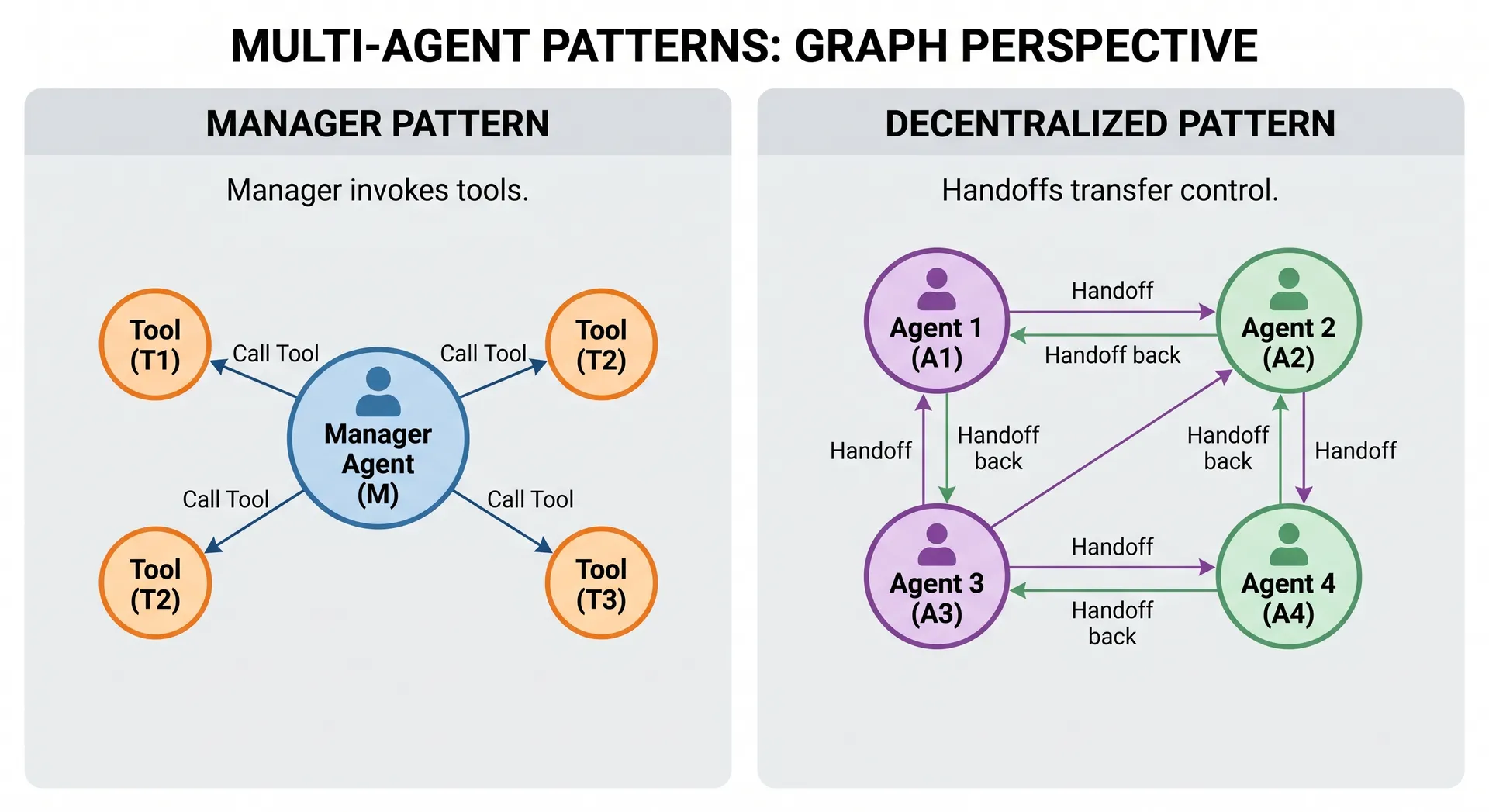
Manager_Pattern_MEDIA.png (1208×680)
Decentralized_Pattern.png (1208×680)
Guardrails机制
门禁机制,用于保护隐私,提高安全性
可以针对不同的组成部分设置对应的提示词
Guardrails类型:相关性分类,输入安检,PII(个人身份信息)筛选,有害言论审查,工具安检,基于规则的保护,输出检查
这段代码有点复杂得后面读读
from agents import (
    Agent,
    GuardrailFunctionOutput,
    InputGuardrailTripwireTriggered,
    RunContextWrapper,
    Runner,
    TResponseInputItem,
    input_guardrail,
    Guardrail,
    GuardrailTripwireTriggered,
)
from pydantic import BaseModel


class ChurnDetectionOutput(BaseModel):
    is_churn_risk: bool
    reasoning: str


churn_detection_agent = Agent(
    name="Churn Detection Agent",
    instructions=(
        "Identify if the user message indicates a potential customer churn risk."
    ),
    output_type=ChurnDetectionOutput,
)


@input_guardrail
async def churn_detection_tripwire(
    ctx: RunContextWrapper[None],
    agent: Agent,
    input: str | list[TResponseInputItem],
) -> GuardrailFunctionOutput:
    result = await Runner.run(
        churn_detection_agent,
        input,
        context=ctx.context,
    )

    return GuardrailFunctionOutput(
        output_info=result.final_output,
        tripwire_triggered=result.final_output.is_churn_risk,
    )


customer_support_agent = Agent(
    name="Customer Support Agent",
    instructions=(
        "You are a customer support agent. You help customers with their questions."
    ),
    input_guardrails=[
        Guardrail(guardrail_function=churn_detection_tripwire),
    ],
)


async def main():
    # This should be ok
    await Runner.run(customer_support_agent, "Hello!")
    print("Hello message passed")

    # This should trip the guardrail
    try:
        await Runner.run(
            customer_support_agent,
            "I think I might cancel my subscription",
        )
        print("Guardrail didn't trip - this is unexpected")
    except GuardrailTripwireTriggered:
        print("Churn detection guardrail tripped")
人工干预
-
兜底
-
记录每一次人工干预可以以此更新迭代
触发人工介入:
-
超出失败阈值(Exceeding failure thresholds): 这与大模型底层的
while循环直接相关。必须在系统中设定明确的重试上限。 -
高风险操作(High-risk actions): 对于具有破坏性、不可逆转或涉及资金的功能,AI 只能做“提案(Proposal)”,不能做“决断(Execution)”,这类需要人工批准
Use an agent when complex judgment is required, rules are hard to maintain, or there is a large amount of unstructured information to process.
An agent is essentially an automated workflow.
Agent composition: LLM, tools, instructions
Deciding on the LLM
LLM selection: start by using the most capable model for the task, then find the balance point by replacing it with smaller models.
-
Set up evaluations to establish a baseline for model performance
-
Look at accuracy
-
Optimize cost and latency
Deciding on tools
LLMs use APIs to call models.
For apps without APIs, the agent operates their UI to perform actions.
Categories of tools:
-
Data: allows the LLM to retrieve needed information
-
Action: interacts with systems
-
Orchestration: the agent itself can serve as a tool for other agents to use
SDK: an encapsulated code library, the infrastructure for large model tool calling, memory, and writing
Best practices for instructions:
Reuse existing documentation, use clear language, break down tasks, handle edge cases
Orchestration
There are two orchestration modes: single-model and multi-model
while loop
All orchestration has a "run" (start), then begins a loop until
an exit condition is reached (tool calls, a certain structured output, errors, or reaching a maximum number of turns.)
The loop ends only in these cases: 1. a final-output call is invoked 2. no tool is called and a result is returned
Input -> LLM -> call / do not call tools -> return to step two / output
Prompt engineering for complex multi-agent tasks: using an extensible set of prompts can simplify maintenance and reduce the cost of adding cases
Before using multiple models: maximize a single agent’s capabilities first.
Reasons to use multiple models:
-
The logic is too complex and a single prompt can no longer scale
-
Tool overlap is too high (overlapping)
Two multi-agent modes:
-
Centralized: a central agent manages multiple tool agents (similar to calling functions)
-
Decentralized: multiple agents collaborate with one another (similar to handing off tasks)
Manager_Pattern_MEDIA.png (1208×680)
Decentralized_Pattern.png (1208×680)
Guardrails mechanism
Access-control mechanism, used to protect privacy and improve security
Corresponding prompts can be set for different components
Types of guardrails: relevance classification, input screening, PII (personally identifiable information) filtering, harmful speech moderation, tool screening, rule-based protection, output checking
This code is a bit complex and should be read later
from agents import (
    Agent,
    GuardrailFunctionOutput,
    InputGuardrailTripwireTriggered,
    RunContextWrapper,
    Runner,
    TResponseInputItem,
    input_guardrail,
    Guardrail,
    GuardrailTripwireTriggered,
)
from pydantic import BaseModel


class ChurnDetectionOutput(BaseModel):
    is_churn_risk: bool
    reasoning: str


churn_detection_agent = Agent(
    name="Churn Detection Agent",
    instructions=(
        "Identify if the user message indicates a potential customer churn risk."
    ),
    output_type=ChurnDetectionOutput,
)


@input_guardrail
async def churn_detection_tripwire(
    ctx: RunContextWrapper[None],
    agent: Agent,
    input: str | list[TResponseInputItem],
) -> GuardrailFunctionOutput:
    result = await Runner.run(
        churn_detection_agent,
        input,
        context=ctx.context,
    )

    return GuardrailFunctionOutput(
        output_info=result.final_output,
        tripwire_triggered=result.final_output.is_churn_risk,
    )


customer_support_agent = Agent(
    name="Customer Support Agent",
    instructions=(
        "You are a customer support agent. You help customers with their questions."
    ),
    input_guardrails=[
        Guardrail(guardrail_function=churn_detection_tripwire),
    ],
)


async def main():
    # This should be ok
    await Runner.run(customer_support_agent, "Hello!")
    print("Hello message passed")

    # This should trip the guardrail
    try:
        await Runner.run(
            customer_support_agent,
            "I think I might cancel my subscription",
        )
        print("Guardrail didn't trip - this is unexpected")
    except GuardrailTripwireTriggered:
        print("Churn detection guardrail tripped")
Human intervention
-
Fallback
-
Record every human intervention so it can be used to update and iterate
Triggers for human intervention:
-
Exceeding failure thresholds: This is directly related to the underlying
whileloop of the large model. Clear retry limits must be set in the system. -
High-risk actions: For destructive, irreversible, or fund-related functions, AI can only make a "Proposal" and cannot make an "Execution." These require human approval.