[书]《百年孤独》书评[Book] Review of 'One Hundred Years of Solitude'
高中时期在课本里读了失眠症那章节,就惊叹于这种称为 魔幻现实主义 的写法,近期不知怎么就突然想看 早在读之前我就已经初步了解这本书极其复杂的人物关系,于是果断选择一边读纸质一边 画导图,总算没有陷入书里“时间的迷宫”里
读下来我有三点最大的体会,感觉这三点共同组成了这样一部流放百年的经典
首先是它荒诞魔幻的语言
极富有想象力的描绘像是藤蔓一样诡异扭曲地生长在各个地方:冰块、长廊、性爱、灾难,何其瑰丽,何其富有魅力。而神奇的是,这种语言话里有话,有些字眼有着极其丰富的内涵,有时他们以预言的形式呈现、有时只是描述、有时是警告、它们分散在各个地方,组成了这具长篇小说巨人的肌肉
然后是它奇特跳跃故事叙述
加西亚用他顶级魔幻的语言变着戏法的讲一个已经被遗忘的、发生于过去的故事。开篇第一句如此经典不必多说,在后面的部分,我们可以看到反复的“闪前”——作者把我们带到一个“过去的将来时刻”,于是我们可以看到,前一秒奥雷里亚诺还是一个小孩子、后一秒就出现在刑场。除了章节作为齿缘的滚动以外,这种提前预知读者的叙述魔术同时推进了故事的走向,并且让读者沉迷于这种混乱的时间中、与故事的人物分享同一份宿命重压。我愿这部分看是本书的骨架,下面就是本书的核心
最后是遗忘的宿命以及注定的孤独
如果说有一个字眼统领整个故事的话,那就绝对是“孤独”,命中注定的孤独笼罩着遗忘之地马孔多:“家族的第一个人被捆在树上、最后一个人正被蚂蚁吃掉”,失败的奥雷里亚诺.布恩迪亚上校,被遗忘的车站屠杀以及唯一存活的何塞.奥尔卡蒂奥,再也没有说话的梅梅、解读出预言却无力回天的奥雷里亚诺.巴比伦以及那个出生就是终点的猪尾巴奥雷里亚诺。家族的每个人恪守着自己的孤独,无一逃离命运、被遗忘的命运
文章最后揭示的梅尔基亚德斯谜语更是神之一笔,整个“百年孤独”就是一个首尾衔接的预言,故事开篇就简单介绍了混乱的家庭关系与“猪尾巴”象征的终点,我们在真正踏入那段历史之前就知道了这段悲剧的结局。这本书就是那些终将被解读出内容的羊皮纸,这个故事就是那些羊皮纸上被遗忘的“百年孤独”
我不知道怎么理解这层孤独以及故事背后,作者想表达的东西,也许我会有天回看并得到新的感悟,也许我会认真了解故事背景与作者动机然后深刻理解每一句话的内涵并得出一个必然的结论。 也许我再不会读第二次,让这个百年孤独的家族不再会有第二次机会在我的世界里出现
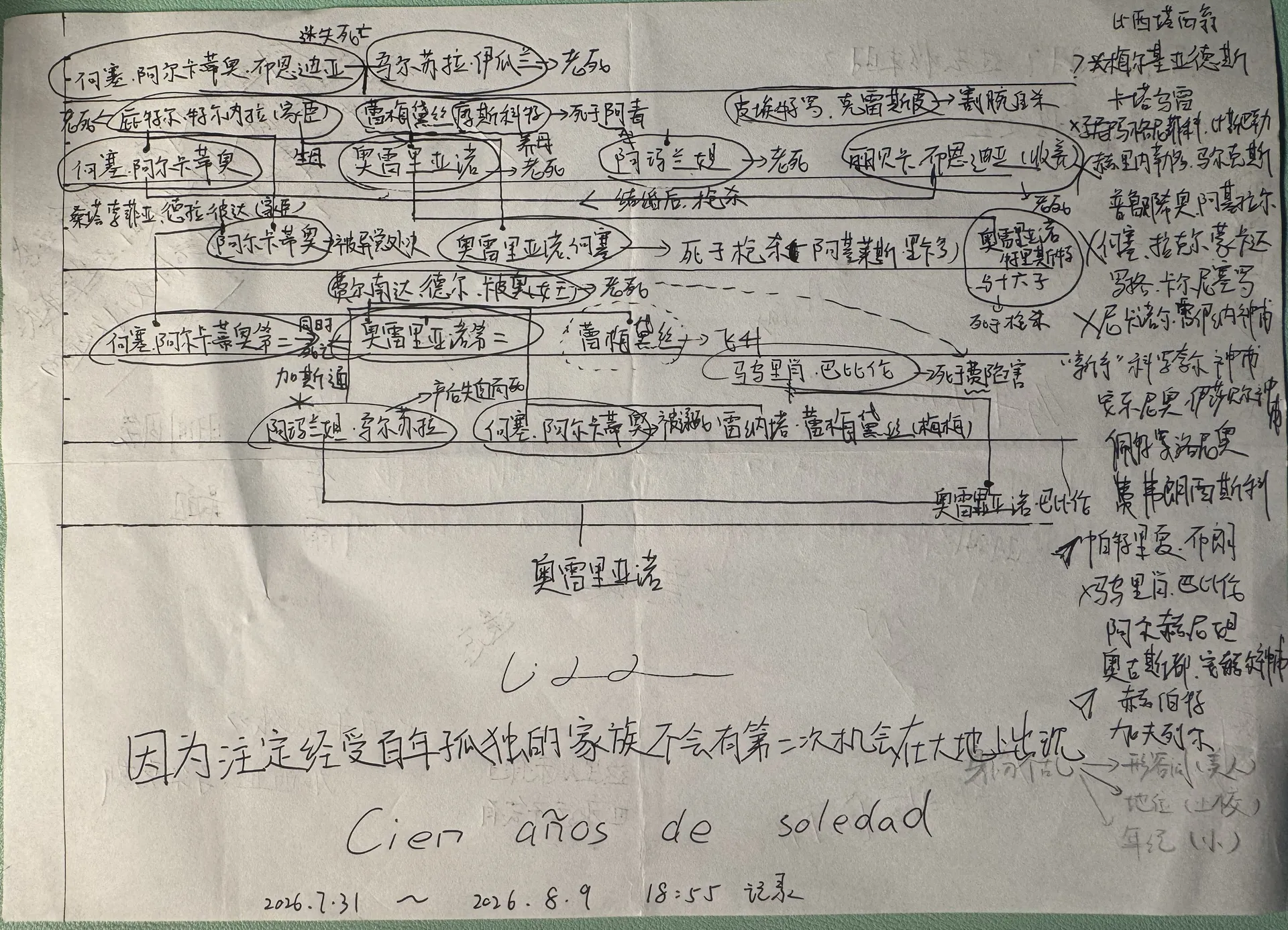
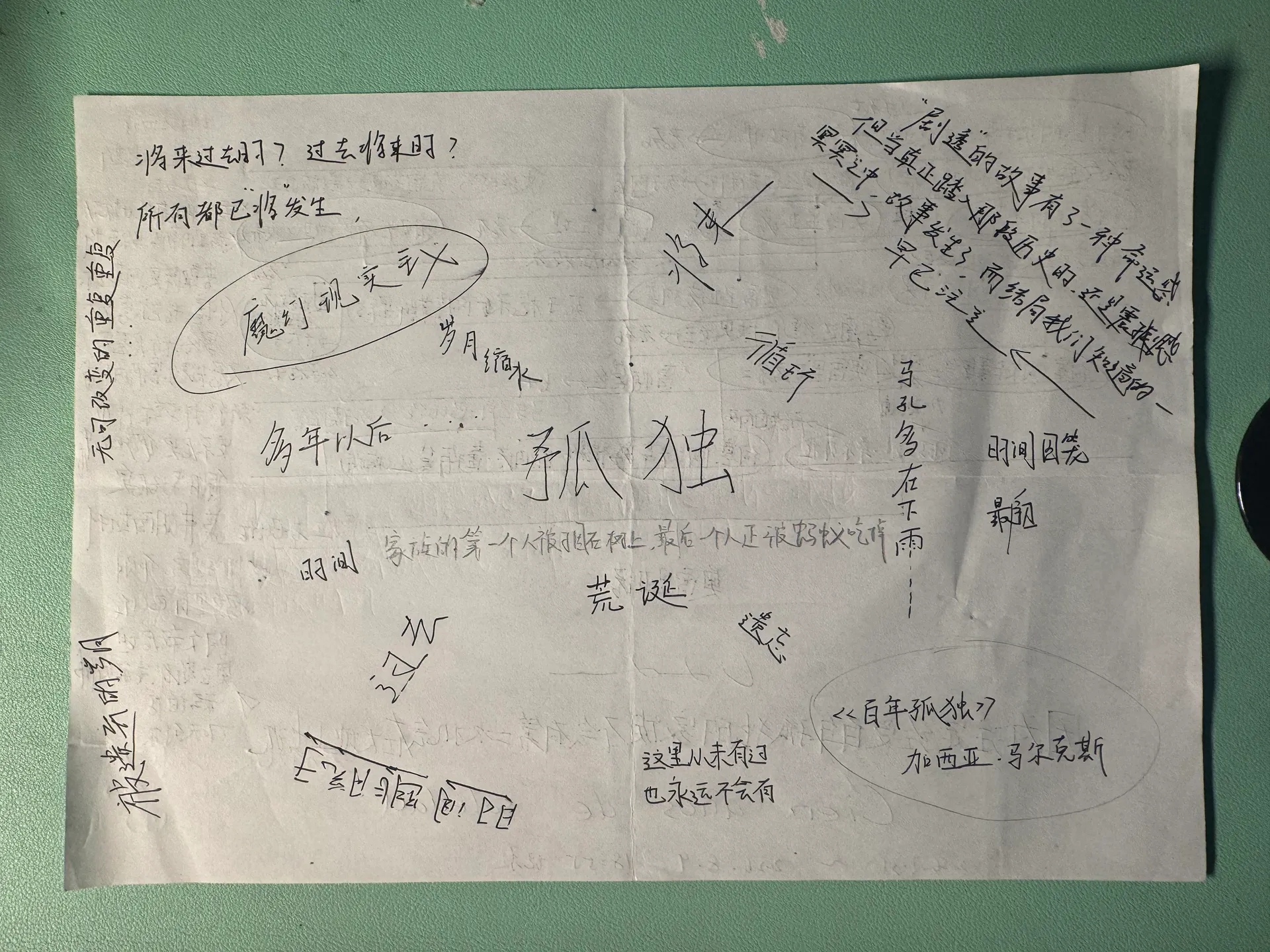
During high school, I read the chapter about the insomnia plague in our textbook and was amazed by this writing style called magical realism. Recently, for some reason, I suddenly wanted to read it again. Before reading, I had already gained a preliminary understanding of the book's extremely complex character relationships, so I decisively chose to read the paper book while drawing a mind map simultaneously, and finally managed not to get lost in the book's 'labyrinth of time.'
After reading, I have three main takeaways, which I feel together form such a classic that has endured for a century.
First, its absurd and magical language
The imaginative depictions grow like vines, twisted and eerie, appearing everywhere: ice, corridors, sex, disasters—how magnificent, how charming. And miraculously, this language has hidden meanings; some words carry extremely rich connotations. Sometimes they appear as prophecies, sometimes as descriptions, sometimes as warnings. Scattered throughout, they form the muscles of this novelistic giant.
Second, its peculiar and leaping narrative
García uses his top-tier magical language to tell, in various ways, a story of the past that has been forgotten. The opening sentence is so classic that I need not elaborate. In later parts, we see repeated 'flash-forwards'—the author takes us to a 'future moment of the past,' so that one second Aureliano is still a child, and the next he appears at the firing squad. Besides the rolling of chapters as cogs, this narrative magic of prematurely informing the reader simultaneously advances the story's direction and immerses readers in this chaotic time, sharing the same oppressive fate with the characters. I consider this part the skeleton of the book, and below is the core.
Finally, the fate of forgetting and destined solitude
If there is one word that governs the entire story, it is definitely 'solitude.' Destined solitude envelops the forgotten Macondo: 'The first of the family is tied to a tree, the last is being eaten by ants.' The failed Colonel Aureliano Buendía, the forgotten massacre at the station and the sole survivor José Arcadio, the never-again-speaking Meme, Aureliano Babilonia who deciphered the prophecies but was powerless to change fate, and the pig-tailed Aureliano whose birth was already the end. Every member of the family adheres to their own solitude, none escaping destiny—the fate of being forgotten.
The revelation of Melquíades' riddle at the end is a stroke of genius: the entire 'One Hundred Years of Solitude' is a self-contained prophecy. The story's opening briefly introduces the chaotic family relationships and the endpoint symbolized by the 'pig's tail.' We know the outcome of this tragedy before truly stepping into that history. This book is the parchment that will eventually be deciphered; this story is the forgotten 'one hundred years of solitude' on that parchment.
I don't know how to interpret this solitude and what the author wanted to express behind the story. Perhaps one day I will look back and gain new insights; perhaps I will seriously study the background and the author's motivations, deeply understand the connotations of every sentence, and arrive at an inevitable conclusion.
Perhaps I will never read it a second time, so that this family of one hundred years of solitude will not have a second chance to appear in my world.